COMPUTER TRAINING = JOBS? A PD op-ed (online not there but at the Washington Post) says George Bush's enthusiasm for computer training is somewhat beside the point in an economy that isn't creating jobs that use the trainees' new skills. Chris Seper comments. I respond at Cleveland Digital Vision.
1.22.2004
BLOGGING OF THE PRESIDENT NOT ON WCPN THIS SUNDAY: From Chris Lydon's blog via Atrios:
Sunday January 25 from 9-11 pm EST, from Minnesota Public Radio and airing on public radio stations nationwide (here's a list of stations playing the program). Christopher Lydon will be hosting the first sustained blog conversation on network radio and you’re all invited to join in. The purpose is to air out the internet effects that the political campaign has suddenly made obvious. We want to encompass the new voices and communities, the critique of institutional journalism, the expressive possibilities beyond politics, the doubts, the hype, and the truth. Among the guests will be Atrios, Andrew Sullivan, and many more (a lot of biggies, we'll be updating the site daily) including you, if you’ll tune in, phone in, or just blog it as we speak.
Neither WCPN nor WKSU is on the list of stations, and it ain't on WCPN's schedule.
WCPN's phone: 216-432-3700. Fax: 216-432-3681. Dave Kanzeg is director of programming. I don't have his email but you can write to comments@wcpn.org.
Sunday January 25 from 9-11 pm EST, from Minnesota Public Radio and airing on public radio stations nationwide (here's a list of stations playing the program). Christopher Lydon will be hosting the first sustained blog conversation on network radio and you’re all invited to join in. The purpose is to air out the internet effects that the political campaign has suddenly made obvious. We want to encompass the new voices and communities, the critique of institutional journalism, the expressive possibilities beyond politics, the doubts, the hype, and the truth. Among the guests will be Atrios, Andrew Sullivan, and many more (a lot of biggies, we'll be updating the site daily) including you, if you’ll tune in, phone in, or just blog it as we speak.
Neither WCPN nor WKSU is on the list of stations, and it ain't on WCPN's schedule.
WCPN's phone: 216-432-3700. Fax: 216-432-3681. Dave Kanzeg is director of programming. I don't have his email but you can write to comments@wcpn.org.
1.10.2004
MY BIG FOUR FOR '04: Here I thought I'd get all clever and kick off a new blogging year with a list of four big, big ideas that should move to the city's front burner this year. Good idea, yes? So good that David Eden beat me to it.
At first I was kind of deflated. Then I read Dave's list and cheered up. "Big ideas for the next hundred years?" Two more downtown real estate parlays (one with a sports gimmick attached), plus a bureaucratic reorganization, plus a bigger airport? (Gosh, you think they'll still be using runways in 2104? Or are we hoping for direct service from Medina County to Mars?) This does not exactly rise to the level of Alfred Kelly's canal move.
Okay, so if I'm so smart, what are my Big Four? Here we go:
1) Send Cleveland to college. Eden is right to put the expansion of CSU on his list, but "University Village" and Division I football miss the point totally. Cleveland now has the lowest proportion of adults with college degrees among the country's fifty biggest cities. Our best prospects for population growth come from the relative stability of poorer young people, plus immigration from Puerto Rico, Latin America and elsewhere. We need a university that's the absolute best at educating working-class students for scientific and professional careers and high-skill technical work. (Think City College of New York in the '30, '40 and '50s.) The community can help start CSU on this road by committing serious resources to send tens of thousands of our undereducated, underemployed adults and kids to CSU, and to help CSU develop world-class teaching and support systems for them. Let's change our city from the worst educated to one of the best educated in its class!
2) Play the Canada card. Let's stop beating around the Great Lakes Regional bush and get to the point: we're closer to London than to Columbus, closer to Toronto than to Cincinnati, and there's no reason why a few miles of water should stop us from linking up. Look at a map without the national borders: what great metropolis should be our natural center of gravity? Where would I-77 and I-71 go if they could? Maybe Jim Rhodes was right about a bridge, maybe not; but it's not necessary to argue about it because we can put a ferry in service for much less than the Port spent on the Rock Hall, and open up a whole new northern neighborhood. This is a total no-brainer. Let's stop studying the possibility and get on with it!
3) Home grown affordable energy. Northeast Ohio is a huge importer of natural gas, and we pay some of the highest electric bills in the U.S. In the city, many of those bills come from Public Power, which charges almost as much as First Energy and sends a lot of the money elsewhere for purchased power. This all impinges directly on household and business budgets, drains dollars out of local circulation, and represents missed opportunities for local enterprise. Plenty of people are on top of this -- Entrepreneurs for Sustainability, Green Energy Ohio, H2O, EcoCity, etc., etc. -- but energy tech is a big long-term local market with a lot of entry points that deserves more public focus than it's getting. (And here's a really fascinating "big idea" that somebody in Cleveland should be checking out.)
4) Neighborhood government. It's arguable that some public functions in greater Cleveland would be strengthened by more "regional" public authority -- economic development investment, transportation, broad environmental and land use oversight, etc. It's equally arguable that Cleveland neighborhoods suffer from too much centralized control of things that small suburbs are very happy to run for themselves -- playgrounds, street repair, local planning and zoning policies, not to mention the process of democracy itself. Each of Cleveland's 21 wards has as many people as the average Cuyahoga County city -- cities that have their own governments, taxing and bonding authority, and civic institutions. It's hard not to notice that most people, given a choice, choose to live in the smaller places with human-scale governments. Meanwhile, in Cleveland, virtually all our vaunted neighborhood revitalization of the last twenty years has been driven by neighborhood development agencies (the CDCs) in alliance with ward Councilmen empowered by growing "ward allocations" of funds under their control. Left to centralized City Hall departments, none of it would have taken place -- no matter what past and present Mayors would like you to believe. If 2004 is going to see a real debate about government reorganization, that debate must help to sort out where power and policy initiative should be scaled down to the neighborhoods, not just up to the county or region.
So that's my Big Four for '04. I think I'll try to make them the biggest part of Cleveland Diary's agenda for the coming year. Better than just bitching and moaning about politicians, right? Of course I also put a big priority on computerizing and networking everybody in the city, but you can read about that at www.digitalvision.blogspot.com. And somewhere along the line I have to explain why I think more unions and collective bargaining are vital for the whole northeast Ohio economy. And I'm sure there will be other things I just gotta yap about.
But these should keep me busy for a while.
At first I was kind of deflated. Then I read Dave's list and cheered up. "Big ideas for the next hundred years?" Two more downtown real estate parlays (one with a sports gimmick attached), plus a bureaucratic reorganization, plus a bigger airport? (Gosh, you think they'll still be using runways in 2104? Or are we hoping for direct service from Medina County to Mars?) This does not exactly rise to the level of Alfred Kelly's canal move.
Okay, so if I'm so smart, what are my Big Four? Here we go:
1) Send Cleveland to college. Eden is right to put the expansion of CSU on his list, but "University Village" and Division I football miss the point totally. Cleveland now has the lowest proportion of adults with college degrees among the country's fifty biggest cities. Our best prospects for population growth come from the relative stability of poorer young people, plus immigration from Puerto Rico, Latin America and elsewhere. We need a university that's the absolute best at educating working-class students for scientific and professional careers and high-skill technical work. (Think City College of New York in the '30, '40 and '50s.) The community can help start CSU on this road by committing serious resources to send tens of thousands of our undereducated, underemployed adults and kids to CSU, and to help CSU develop world-class teaching and support systems for them. Let's change our city from the worst educated to one of the best educated in its class!
2) Play the Canada card. Let's stop beating around the Great Lakes Regional bush and get to the point: we're closer to London than to Columbus, closer to Toronto than to Cincinnati, and there's no reason why a few miles of water should stop us from linking up. Look at a map without the national borders: what great metropolis should be our natural center of gravity? Where would I-77 and I-71 go if they could? Maybe Jim Rhodes was right about a bridge, maybe not; but it's not necessary to argue about it because we can put a ferry in service for much less than the Port spent on the Rock Hall, and open up a whole new northern neighborhood. This is a total no-brainer. Let's stop studying the possibility and get on with it!
3) Home grown affordable energy. Northeast Ohio is a huge importer of natural gas, and we pay some of the highest electric bills in the U.S. In the city, many of those bills come from Public Power, which charges almost as much as First Energy and sends a lot of the money elsewhere for purchased power. This all impinges directly on household and business budgets, drains dollars out of local circulation, and represents missed opportunities for local enterprise. Plenty of people are on top of this -- Entrepreneurs for Sustainability, Green Energy Ohio, H2O, EcoCity, etc., etc. -- but energy tech is a big long-term local market with a lot of entry points that deserves more public focus than it's getting. (And here's a really fascinating "big idea" that somebody in Cleveland should be checking out.)
4) Neighborhood government. It's arguable that some public functions in greater Cleveland would be strengthened by more "regional" public authority -- economic development investment, transportation, broad environmental and land use oversight, etc. It's equally arguable that Cleveland neighborhoods suffer from too much centralized control of things that small suburbs are very happy to run for themselves -- playgrounds, street repair, local planning and zoning policies, not to mention the process of democracy itself. Each of Cleveland's 21 wards has as many people as the average Cuyahoga County city -- cities that have their own governments, taxing and bonding authority, and civic institutions. It's hard not to notice that most people, given a choice, choose to live in the smaller places with human-scale governments. Meanwhile, in Cleveland, virtually all our vaunted neighborhood revitalization of the last twenty years has been driven by neighborhood development agencies (the CDCs) in alliance with ward Councilmen empowered by growing "ward allocations" of funds under their control. Left to centralized City Hall departments, none of it would have taken place -- no matter what past and present Mayors would like you to believe. If 2004 is going to see a real debate about government reorganization, that debate must help to sort out where power and policy initiative should be scaled down to the neighborhoods, not just up to the county or region.
So that's my Big Four for '04. I think I'll try to make them the biggest part of Cleveland Diary's agenda for the coming year. Better than just bitching and moaning about politicians, right? Of course I also put a big priority on computerizing and networking everybody in the city, but you can read about that at www.digitalvision.blogspot.com. And somewhere along the line I have to explain why I think more unions and collective bargaining are vital for the whole northeast Ohio economy. And I'm sure there will be other things I just gotta yap about.
But these should keep me busy for a while.
1.05.2004
PUTTING CHILDREN FIRST... OUT ON THE STREET: I ran into Tim Wells in the soft drink aisle at the Clark Ave. Topps on Saturday. Tim ran Clark Recreation Center in the Stockyards neighborhood, back when I worked for the local CDC. Now he's in charge of the Recreation Division's citywide "organized sports" programs -- what's left of them after the budget cuts.
Tim told me that the 16% cut in the Parks and Recreation budget means that about 300 Summer rec workers won't be hired this year, which means very short staff for programs at the City's 20 recreation centers and 19 neighborhood pools -- and no staffed programs at 30 neighborhood playgrounds that had them last year. The 19 pools will only be open for six weeks, from Tuesday through Sunday.
Think about this for a minute. The City of Cleveland has about 470,000 residents, of whom something like 100,000 are school-age kids. Last Summer, the City had over sixty places where those kids could go for some kind of organized, supervised recreation -- one place for every 1,500 kids, more or less. This Summer, thirty of those places will be gone, and another nineteen (the pools) will be closed for half the season. The ratio of staffed recreation sites to kids will fall as low as 1 to 5,000.
So if you want your child to play safely in a Cleveland neighborhood playground this Summer, and you don't happen to live near a rec center, get ready to go down there and stand guard for a few hours. Be sure to bring a broom and some trash bags along for last night's crop of broken glass... the City will only be cleaning once a month. And try not to do anything that could get you sued, since the City offers no liability coverage for parental volunteers.
Oh, you're working days? Too bad... guess you'll just have to lock the kids in the house with the X-Box for company.
Boy, this is gonna be an awful year.
Tim told me that the 16% cut in the Parks and Recreation budget means that about 300 Summer rec workers won't be hired this year, which means very short staff for programs at the City's 20 recreation centers and 19 neighborhood pools -- and no staffed programs at 30 neighborhood playgrounds that had them last year. The 19 pools will only be open for six weeks, from Tuesday through Sunday.
Think about this for a minute. The City of Cleveland has about 470,000 residents, of whom something like 100,000 are school-age kids. Last Summer, the City had over sixty places where those kids could go for some kind of organized, supervised recreation -- one place for every 1,500 kids, more or less. This Summer, thirty of those places will be gone, and another nineteen (the pools) will be closed for half the season. The ratio of staffed recreation sites to kids will fall as low as 1 to 5,000.
So if you want your child to play safely in a Cleveland neighborhood playground this Summer, and you don't happen to live near a rec center, get ready to go down there and stand guard for a few hours. Be sure to bring a broom and some trash bags along for last night's crop of broken glass... the City will only be cleaning once a month. And try not to do anything that could get you sued, since the City offers no liability coverage for parental volunteers.
Oh, you're working days? Too bad... guess you'll just have to lock the kids in the house with the X-Box for company.
Boy, this is gonna be an awful year.
11.26.2003
LET ME REPEAT MYSELF: From October 10...
No potential candidate for Mayor should get a free ride on this. Reporters and citizens need to make all the players come clean on their budget positions, long before this turns into a posture-fest at the Council committee table. If you think people need to be laid off, who goes first? If there's "fat" to be cut, where is it specifically? If you don't have some useful leadership to offer now, don't come to us talking about leadership in 2005. No Schwartzeneggers need apply.
Of course, this can't happen if all the numbers aren't public.
... The 2004 General Fund projections (and the 2003 numbers to date) -- all the projections -- should be posted prominently on the City's website right now, and updated as the Administration's information changes. This issue, far more than lakefront design or even the Convention Center, cries out for an open transparent public process: "We will have a lot less money than we need next year. What should we do about it?"
No potential candidate for Mayor should get a free ride on this. Reporters and citizens need to make all the players come clean on their budget positions, long before this turns into a posture-fest at the Council committee table. If you think people need to be laid off, who goes first? If there's "fat" to be cut, where is it specifically? If you don't have some useful leadership to offer now, don't come to us talking about leadership in 2005. No Schwartzeneggers need apply.
Of course, this can't happen if all the numbers aren't public.
... The 2004 General Fund projections (and the 2003 numbers to date) -- all the projections -- should be posted prominently on the City's website right now, and updated as the Administration's information changes. This issue, far more than lakefront design or even the Convention Center, cries out for an open transparent public process: "We will have a lot less money than we need next year. What should we do about it?"
MAYOR'S FULL BUDGET STATEMENT ON LINE: I'm happy to report that Mayor Campbell's full statement on budget cuts Monday, and the accompanying press release (with a significant amount of additional detail), are now both available at the City website.
This is a very good first step toward a full, public, transparent debate on the City's financial choices. A good next step would be posting Finance Director Baker's latest revenue results and projections, and the details of proposed cuts, department by department.
If you agree, here's the Mayor's e-mail form.
This is a very good first step toward a full, public, transparent debate on the City's financial choices. A good next step would be posting Finance Director Baker's latest revenue results and projections, and the details of proposed cuts, department by department.
If you agree, here's the Mayor's e-mail form.
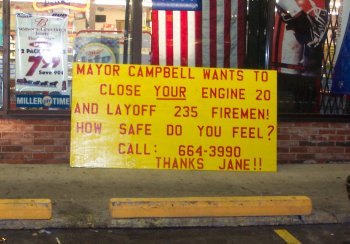
THE FIRST CASUALTY: The sign is still out there at my neighborhood Convenient store, two days after everyone in the city -- including the guys next door at Fire Station 20 -- learned that Mayor Campbell plans to lay off 150 firefighters, not 235, and is proposing to close no stations.
The sign is a lie now, of course. But since nobody signed it, I guess nobody's responsible for correcting it or removing it. It can just sit out there, telling the neighbors something that isn't true but still serves the purpose of the folks who put it up... much like the "2,000 new city workers added in the 1990s" myth that the Mayor's Office apparently promoted to the Plain Dealer, which put it in an editorial and still hasn't corrected it.
Like the Mayor's chief of staff supposedly said to the Firefighters president, "This is war". And in war the first casualty is the truth.
The sign is a lie now, of course. But since nobody signed it, I guess nobody's responsible for correcting it or removing it. It can just sit out there, telling the neighbors something that isn't true but still serves the purpose of the folks who put it up... much like the "2,000 new city workers added in the 1990s" myth that the Mayor's Office apparently promoted to the Plain Dealer, which put it in an editorial and still hasn't corrected it.
Like the Mayor's chief of staff supposedly said to the Firefighters president, "This is war". And in war the first casualty is the truth.
11.24.2003
Campbell plans to cut 700 jobs
Cleveland Mayor Jane Campbell plans to cut more than 700 city jobs, delay the opening of outdoor swimming pools and scrap eight fire companies to help eliminate next year's $61 million budget deficit.... The Parks and Recreation Department and the Service Department, which handles road repair and trash pickup, will each lose 60 jobs... The city will eliminate 60 part-time jobs and not hire 310 seasonal employees for such tasks as snowplowing and trash pickup.
So tell me again, after all the agonizing and hand-wringing, why is a temporary income tax increase not on the table? A quarter-percent surcharge for the last three quarters of 2004 would raise nearly half of the shortfall -- if it was on the ballot March 4 instead of a Convention Center tax. I believe it could pass, given the alternatives.
The safety forces may be grandstanding and exaggerating the dangers, but I can tell you from bitter experience that closing eight fire stations will slow response times and risk lives. And if you think that safety, recreation, and street repair failures aren't serious "quality of life" issues that will drive middle class families out -- along with the laid off workers themselves -- you just haven't been paying attention.
Correction... The Mayor's proposal calls for eliminating eight fire companies, not stations. Apparently a company is the crew of a truck, more or less. There is no proposal on the table to close any stations. This is a obviously a big difference. The Mayor says trucks and response times can be protected through changes in work rules, i.e. one fewer firefighter per truck.
Cleveland Mayor Jane Campbell plans to cut more than 700 city jobs, delay the opening of outdoor swimming pools and scrap eight fire companies to help eliminate next year's $61 million budget deficit.... The Parks and Recreation Department and the Service Department, which handles road repair and trash pickup, will each lose 60 jobs... The city will eliminate 60 part-time jobs and not hire 310 seasonal employees for such tasks as snowplowing and trash pickup.
So tell me again, after all the agonizing and hand-wringing, why is a temporary income tax increase not on the table? A quarter-percent surcharge for the last three quarters of 2004 would raise nearly half of the shortfall -- if it was on the ballot March 4 instead of a Convention Center tax. I believe it could pass, given the alternatives.
The safety forces may be grandstanding and exaggerating the dangers, but I can tell you from bitter experience that closing eight fire stations will slow response times and risk lives. And if you think that safety, recreation, and street repair failures aren't serious "quality of life" issues that will drive middle class families out -- along with the laid off workers themselves -- you just haven't been paying attention.
Correction... The Mayor's proposal calls for eliminating eight fire companies, not stations. Apparently a company is the crew of a truck, more or less. There is no proposal on the table to close any stations. This is a obviously a big difference. The Mayor says trucks and response times can be protected through changes in work rules, i.e. one fewer firefighter per truck.
11.23.2003
MY REGIONAL GOVERNMENT PLAN (A THOUGHT EXERCISE): In this media market if not elsewhere, "regionalism" has become one of those words that obscures more than it communicates. Everyone from Thomas to Sam Fulwood, from Peter Lawson Jones (speaking at the last Connections Series event) to the fourteen biggest Cleveland law firms wants to talk "regional government". Elsewhere we're asked to think in terms of the bioregion, the northeast Ohio economic region (nineteen counties, according to REI's Ed Morrison), the "Great Lakes region" (Detroit to Buffalo with part of Ontario thrown in), etc., etc..
So what do they all mean by "region"? Certainly not the same thing. I'm pretty sure that Thomas and Lawson-Jones aren't proposing to create a municipal government that covers Lorain and Akron, while David Beach certainly doesn't think that the bioregion follows county lines. But by sharing the magic word "regional", all these disparate undertakings somehow hum at the same frequency in the public dialogue -- one big "progressive, visionary, 21st century" political harmonic. Sounds real pretty, doesn't it?
Now as my three regular readers know, I think there really is a distinct economic and political entity in Northeast Ohio -- more or less the same territory as REI's nineteen counties -- and I think we should have our own state, or something close to it. But there's a big difference between wanting to devolve centralized political authority to smaller, more locally-empowered entities (a value which is usually called subsidiarity), and wanting to merge smaller political authorities into a bigger one. You can call them both "regionalization", but they're two entirely different things.
"Centralization" is what we're discussing in Cleveland today... the merger of some or all municipal powers from a number of long-existing cities and villages into a single, bigger new municipality of some kind. What, why, who and how are still very vague. So to help clarify things, I want to offer -- purely as a thought exercise -- my very own municipal regionalization plan.
I call it the "BIGGER CLEVELAND PLAN" (and hereby claim copyright on the name, just in case some consultant tries to make a buck off it later).
Here's the way it would work: All of the cities currently sharing a border with the City of Cleveland would simultaneously offer to annex themselves to the City of Cleveland, along with their school districts. The City of Cleveland would accept their offer. Period. Full stop.
Of course nothing is that simple. The City of Cleveland's Home Rule Charter would have to be amended to redraw ward lines to include all those new citizens. And the process of incorporating the assets and employees of the various disappearing suburbs into Cleveland's would be complicated and stressful (no doubt providing all the legal work that those fourteen law firms are hoping for). But with strong, self-effacing leadership from all sides -- the kind of leadership everyone is demanding now from Jane Campbell and Frank Jackson -- I'm sure we could get through it.
In order of population, the annexed cities and villages would include Parma, Lakewood, Euclid, Cleveland Heights, Garfield Heights, Shaker Heights, East Cleveland, Maple Heights, South Euclid, Brook Park, Fairview Park, Warrensville Heights, Brooklyn, Newburgh Heights, Brooklyn Heights, Bratenahl, Cuyahoga Heights, and Linndale.
These eighteen municipalities -- the actual "first ring suburbs" -- have a total of about 450,000 residents, so their annexation would almost double Cleveland's population to over 925,000... back to Number 1 in Ohio and Number 11 in the U.S.
The combined Bigger Cleveland would have:
-- a poverty rate of 17%, compared to Smaller Cleveland's 26%
-- 19% of its adult residents with college degrees, compared to Smaller Cleveland's 11%
-- a public school system with a significant number of middle-income children and parents (at least at first) and a significant number of its teachers and administrators actually living in the district
-- lots of nice neighborhoods for its city employees to live in, even with the residency rule
-- some really nice new city parks and recreation centers open to all Cleveland residents (ever been to Brooklyn's Natatorium?)
-- a stronger property and income tax base, including some still-growing commercial centers and industrial parks
-- lots more political clout.
Of course, Smaller Cleveland residents would lose some political ground, too, since the former suburban voters would outnumber us in Bigger Cleveland (and they turn out better, too). African Americans in Smaller Cleveland would find themselves back in the minority, after decades of edging toward real political dominance in the city... a serious sacrifice for a community whose voting strength is currently its only way to get to the jobs-and-power table.
Nonetheless, I believe that, on balance, the Bigger Cleveland Plan as I have proposed it would be seen by most Smaller Cleveland residents as too good an offer to pass up, if only for the potential value to our schoolkids. And it has the advantage of being very straightforward: All we need is for those eighteen inner ring suburbs to get together and decide to be annexed to Cleveland, as provided under current state law.
Of course it would have to start with the eighteen suburbs themselves. I would think a good start would be for well-known regionalization fans Peter Lawson Jones and Jimmy Dimora to go around to all the city councils, school boards, and ward clubs in those municipalities to get the ball rolling. They could undoubtedly count on getting help from lots of local residents -- for example, attorneys from the fourteen biggest law firms -- who share the regional vision and are tired of being held back by the old-fashioned, parochial, inefficient communities where they live.
I would personally pay good money to hear those conversations -- especially Lawson-Jones making a pitch to the Shaker Heights school board.
Well, that's my Bigger Cleveland Plan. I wonder how long it will take for the petitions to start circulating in Shaker Heights, Cleveland Heights, Euclid, Parma and Lakewood? Or to put it another way... when does ice skating season start in Hell?
So what do they all mean by "region"? Certainly not the same thing. I'm pretty sure that Thomas and Lawson-Jones aren't proposing to create a municipal government that covers Lorain and Akron, while David Beach certainly doesn't think that the bioregion follows county lines. But by sharing the magic word "regional", all these disparate undertakings somehow hum at the same frequency in the public dialogue -- one big "progressive, visionary, 21st century" political harmonic. Sounds real pretty, doesn't it?
Now as my three regular readers know, I think there really is a distinct economic and political entity in Northeast Ohio -- more or less the same territory as REI's nineteen counties -- and I think we should have our own state, or something close to it. But there's a big difference between wanting to devolve centralized political authority to smaller, more locally-empowered entities (a value which is usually called subsidiarity), and wanting to merge smaller political authorities into a bigger one. You can call them both "regionalization", but they're two entirely different things.
"Centralization" is what we're discussing in Cleveland today... the merger of some or all municipal powers from a number of long-existing cities and villages into a single, bigger new municipality of some kind. What, why, who and how are still very vague. So to help clarify things, I want to offer -- purely as a thought exercise -- my very own municipal regionalization plan.
I call it the "BIGGER CLEVELAND PLAN" (and hereby claim copyright on the name, just in case some consultant tries to make a buck off it later).
Here's the way it would work: All of the cities currently sharing a border with the City of Cleveland would simultaneously offer to annex themselves to the City of Cleveland, along with their school districts. The City of Cleveland would accept their offer. Period. Full stop.
Of course nothing is that simple. The City of Cleveland's Home Rule Charter would have to be amended to redraw ward lines to include all those new citizens. And the process of incorporating the assets and employees of the various disappearing suburbs into Cleveland's would be complicated and stressful (no doubt providing all the legal work that those fourteen law firms are hoping for). But with strong, self-effacing leadership from all sides -- the kind of leadership everyone is demanding now from Jane Campbell and Frank Jackson -- I'm sure we could get through it.
In order of population, the annexed cities and villages would include Parma, Lakewood, Euclid, Cleveland Heights, Garfield Heights, Shaker Heights, East Cleveland, Maple Heights, South Euclid, Brook Park, Fairview Park, Warrensville Heights, Brooklyn, Newburgh Heights, Brooklyn Heights, Bratenahl, Cuyahoga Heights, and Linndale.
These eighteen municipalities -- the actual "first ring suburbs" -- have a total of about 450,000 residents, so their annexation would almost double Cleveland's population to over 925,000... back to Number 1 in Ohio and Number 11 in the U.S.
The combined Bigger Cleveland would have:
-- a poverty rate of 17%, compared to Smaller Cleveland's 26%
-- 19% of its adult residents with college degrees, compared to Smaller Cleveland's 11%
-- a public school system with a significant number of middle-income children and parents (at least at first) and a significant number of its teachers and administrators actually living in the district
-- lots of nice neighborhoods for its city employees to live in, even with the residency rule
-- some really nice new city parks and recreation centers open to all Cleveland residents (ever been to Brooklyn's Natatorium?)
-- a stronger property and income tax base, including some still-growing commercial centers and industrial parks
-- lots more political clout.
Of course, Smaller Cleveland residents would lose some political ground, too, since the former suburban voters would outnumber us in Bigger Cleveland (and they turn out better, too). African Americans in Smaller Cleveland would find themselves back in the minority, after decades of edging toward real political dominance in the city... a serious sacrifice for a community whose voting strength is currently its only way to get to the jobs-and-power table.
Nonetheless, I believe that, on balance, the Bigger Cleveland Plan as I have proposed it would be seen by most Smaller Cleveland residents as too good an offer to pass up, if only for the potential value to our schoolkids. And it has the advantage of being very straightforward: All we need is for those eighteen inner ring suburbs to get together and decide to be annexed to Cleveland, as provided under current state law.
Of course it would have to start with the eighteen suburbs themselves. I would think a good start would be for well-known regionalization fans Peter Lawson Jones and Jimmy Dimora to go around to all the city councils, school boards, and ward clubs in those municipalities to get the ball rolling. They could undoubtedly count on getting help from lots of local residents -- for example, attorneys from the fourteen biggest law firms -- who share the regional vision and are tired of being held back by the old-fashioned, parochial, inefficient communities where they live.
I would personally pay good money to hear those conversations -- especially Lawson-Jones making a pitch to the Shaker Heights school board.
Well, that's my Bigger Cleveland Plan. I wonder how long it will take for the petitions to start circulating in Shaker Heights, Cleveland Heights, Euclid, Parma and Lakewood? Or to put it another way... when does ice skating season start in Hell?
11.17.2003
11.08.2003
ISSUE 1: TECHS AND THE CITY
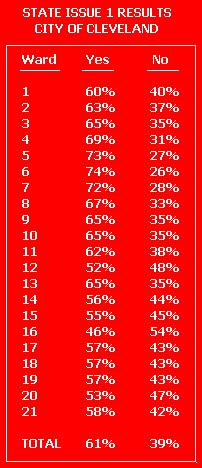
How State Issue 1 did in the City of Cleveland:
(Ward map here.)
Issue 1 got majority support in twenty out of 21 Cleveland wards (the exception was Ward 16, Old Brooklyn). It broke 60% in all eleven East Side wards as well as Ward 13 (Tremont-Downtown-Goodrich Park).
The overall City result of 61-39% was basically identical to the rest of Cuyahoga County at 63-37%. But Cleveland's voter turnout of about 38,000 -- 11% of eligible adults -- was far lower than the rest of the county, where almost a third of all adults voted. This is not surprising -- Cleveland had only three judgeships and Issue 1 on its ballot, whereas many suburbs were electing mayors and city councils and voting on high-profile issues -- but it was unfortunate for Issue 1 backers, who might well have netted 15,000 to 20,000 votes from a higher city turnout. (The issue failed by only 45,000 votes statewide.)
On its face, there was nothing exceptional about the city's support for the issue. It was strong in this county, in NEO generally, and in Democratic-voting areas; it was weakest downstate and in Republican-dominated areas. While Issue 1 was sponsored by a GOP governor with the support of a GOP legislature, its basic pitch -- big new government investment to create new high-paying tech jobs -- seemed far more resonant for labor and city Democrats than for most white-collar Republicans, let alone farmers. And that's pretty much how the votes fell.
But I think Cleveland's vote is worth some attention nonetheless. Remember, these are the same voters who, according to polls, would have buried a Convention Center tax if it had been on this ballot. These are the people who are dismissed by some as too short-sighted, parochial and manufacturing-obsessed to embrace a new golden age of entrepreneurial wealth creation and creative-class high life. Thus this is the city whose very political existence is seen in some quarters as an obstacle to regional progress and prosperity.
And now it turns out we liked the Third Frontier better than they did in the Columbus and Cincinnati suburbs. Why, Frank Jackson's Ward 5 went for it by more than 70%!
Maybe the champions of NEO's new economic paradigm(s) have been looking for love in the wrong places.
More on this next time.
(Ward map here.)
Issue 1 got majority support in twenty out of 21 Cleveland wards (the exception was Ward 16, Old Brooklyn). It broke 60% in all eleven East Side wards as well as Ward 13 (Tremont-Downtown-Goodrich Park).
The overall City result of 61-39% was basically identical to the rest of Cuyahoga County at 63-37%. But Cleveland's voter turnout of about 38,000 -- 11% of eligible adults -- was far lower than the rest of the county, where almost a third of all adults voted. This is not surprising -- Cleveland had only three judgeships and Issue 1 on its ballot, whereas many suburbs were electing mayors and city councils and voting on high-profile issues -- but it was unfortunate for Issue 1 backers, who might well have netted 15,000 to 20,000 votes from a higher city turnout. (The issue failed by only 45,000 votes statewide.)
On its face, there was nothing exceptional about the city's support for the issue. It was strong in this county, in NEO generally, and in Democratic-voting areas; it was weakest downstate and in Republican-dominated areas. While Issue 1 was sponsored by a GOP governor with the support of a GOP legislature, its basic pitch -- big new government investment to create new high-paying tech jobs -- seemed far more resonant for labor and city Democrats than for most white-collar Republicans, let alone farmers. And that's pretty much how the votes fell.
But I think Cleveland's vote is worth some attention nonetheless. Remember, these are the same voters who, according to polls, would have buried a Convention Center tax if it had been on this ballot. These are the people who are dismissed by some as too short-sighted, parochial and manufacturing-obsessed to embrace a new golden age of entrepreneurial wealth creation and creative-class high life. Thus this is the city whose very political existence is seen in some quarters as an obstacle to regional progress and prosperity.
And now it turns out we liked the Third Frontier better than they did in the Columbus and Cincinnati suburbs. Why, Frank Jackson's Ward 5 went for it by more than 70%!
Maybe the champions of NEO's new economic paradigm(s) have been looking for love in the wrong places.
More on this next time.
11.06.2003
FOR ALL YOU WIFI FREAKS: Via the Community Technology Centers Network mailing list, a new website on "muni wireless".
MORE WAL-MART: Yesterday's New York Times has a long article on the Wal-Mart cleaning contractor case, which led to recent arrests at the chain's North Olmsted store along with sixty others.
Various sources in the story say store managers must have known illegal workers were cleaning their stores. The workers interviewed came in on tourist visas, worked long hours for months at a time without days off, and earned less an $7 an hour with no overtime pay. But there's a heartwarming high-tech edge to the story: They were recruited on the Web!
Robert, a Czech who runs a Web site to attract Eastern Europeans to janitorial work, said using foreign cleaners was good for Wal-Mart and for American consumers.
"No American wants to do this job," he said. "If they hired Americans, it would take 10 of them to do the work done by five Czechs. This helps Wal-Mart keep its prices low."
Ah, good old forthright ethnic pride. I'm amazed he's not featured in a Wal-Mart TV ad.
Various sources in the story say store managers must have known illegal workers were cleaning their stores. The workers interviewed came in on tourist visas, worked long hours for months at a time without days off, and earned less an $7 an hour with no overtime pay. But there's a heartwarming high-tech edge to the story: They were recruited on the Web!
Robert, a Czech who runs a Web site to attract Eastern Europeans to janitorial work, said using foreign cleaners was good for Wal-Mart and for American consumers.
"No American wants to do this job," he said. "If they hired Americans, it would take 10 of them to do the work done by five Czechs. This helps Wal-Mart keep its prices low."
Ah, good old forthright ethnic pride. I'm amazed he's not featured in a Wal-Mart TV ad.
11.04.2003
ROLDO: George Nemeth reveals that Roldo Bartimole's next column on Cool Cleveland responds to some earlier entries here and here. (You have to scroll down Roldo's column to get to this... it's the last section headlined "Consequences". )
The first thing I want to say is that I'm so happy that Roldo has a home on line with Cool Cleveland. Can you imagine any other well-known writer in this town being as scrupulous and diligent as this? Thank you, Mr. Mulready and Co.!
Roldo's column speaks for itself (including taking exception to my lumping him in with Crain's as a layoff enthusiast). But what's really interesting is Finance Director Baker's acknowledgment that the last ten years' job growth in City departments was closer to 600 than it was to 2,000 -- the number cited by editorials in both Crain's and the Plain Dealer, as well as Roldo's original City News column.
Why is it so interesting? Because when I contacted Joe Frolik at the PD, who wrote the editorial in question, he told me his source for the bigger number was the Mayor's office. (Joe says he was cautioned that it referred to overall employment growth, not just General Fund departments -- but it turns out that the real numbers in both cases are almost identical.) So it seems that someone at City Hall -- someone who talks to PD reporters -- was eiher badly misinformed or fibbing.
Does it matter? Joe made the same point to me that Roldo makes in his column, i.e. whether it's 2,000 added workers or only 600, the bottom line is still a $50 million deficit that won't go away without some serious payroll cuts somewhere. I've pretty much said what I have to say about this already.
Whatever the City does about all this, however, it's guaranteed to create extreme civic nastiness if the debate is less than honest, factual and transparent. The Case of the Two Thousand New Employees is not a promising start.
The first thing I want to say is that I'm so happy that Roldo has a home on line with Cool Cleveland. Can you imagine any other well-known writer in this town being as scrupulous and diligent as this? Thank you, Mr. Mulready and Co.!
Roldo's column speaks for itself (including taking exception to my lumping him in with Crain's as a layoff enthusiast). But what's really interesting is Finance Director Baker's acknowledgment that the last ten years' job growth in City departments was closer to 600 than it was to 2,000 -- the number cited by editorials in both Crain's and the Plain Dealer, as well as Roldo's original City News column.
Why is it so interesting? Because when I contacted Joe Frolik at the PD, who wrote the editorial in question, he told me his source for the bigger number was the Mayor's office. (Joe says he was cautioned that it referred to overall employment growth, not just General Fund departments -- but it turns out that the real numbers in both cases are almost identical.) So it seems that someone at City Hall -- someone who talks to PD reporters -- was eiher badly misinformed or fibbing.
Does it matter? Joe made the same point to me that Roldo makes in his column, i.e. whether it's 2,000 added workers or only 600, the bottom line is still a $50 million deficit that won't go away without some serious payroll cuts somewhere. I've pretty much said what I have to say about this already.
Whatever the City does about all this, however, it's guaranteed to create extreme civic nastiness if the debate is less than honest, factual and transparent. The Case of the Two Thousand New Employees is not a promising start.
10.29.2003
DOWNTOWN POVERTY DEVELOPMENT: I'm going to propose a new term now. The term is poverty development. I define "poverty development" as the deliberate application of public resources and policies to create jobs at poverty wages.
Please note that poverty development is not what happens when people are thrown out of work, or out of their homes, as the result of public policy. These activities may create poverty -- lots of it -- but that's not usually their goal, it's a side effect of some other goal. In poverty development, on the other hand, the poverty-wage jobs are a stated goal, the poverty-level wages are built into participants' long-range business plans, and ensuring a labor supply at those wage levels is part of the public development activity.
An example of poverty development would be the investment of hundreds of millions of dollars in public funds into a public convention center, in order to create business for hotels and restaurants that pay most of their employees less than living wages.
In this connection, I've posted a page of excerpts from CSU Urban Studies Dean Mark Rosentraub's pro-convention center "study" on my Cleveland Wages Pages website. The most relevant passages are highlighted in red, but the rest of the excerpt is there for context. What it says, in short, is:
A big part of Cleveland's workforce is uneducated and therefore unemployable in the better jobs we hope to create in the technology and financial sectors, so we need to keep growing the "hospitality sector" to provide jobs for them.
I had a long talk a couple of years ago with a young woman who worked as a housekeeper at the Ritz-Carlton, cleaning up after guests who paid up to $300 a night. She described a very demanding job where pay started at about $7 an hour and rose to $9 only at the top of a competitive "incentive" scale. The workers were virtually all Black, Hispanic or recent immigrants; many did not speak English. She had family members and friends at the Marriott who were working in the same circumstances.
These two hotels were flagship projects of the '80s, built with heavy tax abatements to "revitalize the hospitality industry" and "create good jobs for residents". What they created was dead-end jobs at $14-15,000 a year -- less than the City's definition of a Living Wage that's acceptable for subsidized projects --with no prospect of improvement. (Of the 2,500 hotel rooms built downtown since 1980, a grand total of 140 are cleaned by workers with union representation.)
When we talk about preserving and creating "hospitality sector" jobs for uneducated Cleveland residents, these hotels -- and the restaurants around them -- are what we're talking about. That's downtown poverty development. We've had lots of it in the past twenty years, during which the City has become -- predictably -- poorer.
If we're going to spend a lot of public money to benefit uneducated Cleveland workers, as Dean Rosentraub argues, there is another possible strategy: We could spend it to help them get educated and qualified for all those better jobs in technology, finance and health care.
But for some reason, nobody is calling for "leadership" in that direction.
Please note that poverty development is not what happens when people are thrown out of work, or out of their homes, as the result of public policy. These activities may create poverty -- lots of it -- but that's not usually their goal, it's a side effect of some other goal. In poverty development, on the other hand, the poverty-wage jobs are a stated goal, the poverty-level wages are built into participants' long-range business plans, and ensuring a labor supply at those wage levels is part of the public development activity.
An example of poverty development would be the investment of hundreds of millions of dollars in public funds into a public convention center, in order to create business for hotels and restaurants that pay most of their employees less than living wages.
In this connection, I've posted a page of excerpts from CSU Urban Studies Dean Mark Rosentraub's pro-convention center "study" on my Cleveland Wages Pages website. The most relevant passages are highlighted in red, but the rest of the excerpt is there for context. What it says, in short, is:
A big part of Cleveland's workforce is uneducated and therefore unemployable in the better jobs we hope to create in the technology and financial sectors, so we need to keep growing the "hospitality sector" to provide jobs for them.
I had a long talk a couple of years ago with a young woman who worked as a housekeeper at the Ritz-Carlton, cleaning up after guests who paid up to $300 a night. She described a very demanding job where pay started at about $7 an hour and rose to $9 only at the top of a competitive "incentive" scale. The workers were virtually all Black, Hispanic or recent immigrants; many did not speak English. She had family members and friends at the Marriott who were working in the same circumstances.
These two hotels were flagship projects of the '80s, built with heavy tax abatements to "revitalize the hospitality industry" and "create good jobs for residents". What they created was dead-end jobs at $14-15,000 a year -- less than the City's definition of a Living Wage that's acceptable for subsidized projects --with no prospect of improvement. (Of the 2,500 hotel rooms built downtown since 1980, a grand total of 140 are cleaned by workers with union representation.)
When we talk about preserving and creating "hospitality sector" jobs for uneducated Cleveland residents, these hotels -- and the restaurants around them -- are what we're talking about. That's downtown poverty development. We've had lots of it in the past twenty years, during which the City has become -- predictably -- poorer.
If we're going to spend a lot of public money to benefit uneducated Cleveland workers, as Dean Rosentraub argues, there is another possible strategy: We could spend it to help them get educated and qualified for all those better jobs in technology, finance and health care.
But for some reason, nobody is calling for "leadership" in that direction.
10.28.2003
WEIRD SCIENCE (ECONOMICS DIVISION): As I read yesterday's PD article about organized labor pushing a new convention center initiative, the following sentence caught my eye:
In the 1990s, employment gains in Northeast Ohio's hospitality sector - which includes, retail, museums and hotels - almost equaled lost manufacturing jobs, according to CSU analysis.
Read that sentence again. See anything strange? Here's a hint: Do you think of shopping malls as part of the "hospitality sector"? Probably not... but it seems that's the way CSU's study was counting in order to make its highly political point.
The study, by Levin College of Urban Affairs Dean Mark Rosentraub, is available here in PDF format. Published last May, it was waved around a lot during the Summer by Convention Center Tax advocates, but I never looked at it until this morning. The sentence from the PD quoted above is based on a passage that starts on page 14 and continues on page 15, referring to "changes in job levels throughout Northeast Ohio during the 1990s":
There was a loss of more than 22,000 manufacturing jobs... The number of new jobs in the retail, amusement services, museum, and lodging sectors -- which when grouped constitute the hospitality sector -- was almost equal to the loss of manufacturing jobs.
A chart follows which shows the following sectoral job gains (among others) for 1989-2000: 17,314 jobs in retail trade, 191 jobs in hotels and lodging, 4,115 jobs in amusement and recreation, and 478 jobs in museums. The total of these lines -- 22,098 jobs -- is apparently the "hospitality sector" gain that is supposed to almost offset the manufacturing loss. "Retail trade" is three-quarters of that total.
Now I don't know how these things work in the economics biz. Maybe there's some good reason for Dean Rosentraub and his colleagues to have a construct called "the hospitality sector" that includes Wal-Mart, K-Mart, Topps, Builders Square, the corner gas station, the video store, the Dollar Store and some apple stand in Hinckley. But it's hard to see how the performance of such a "sector" tells us anything useful about the economic impact of Cleveland's downtown convention and tourist business.
But who cares?. It's a statistic. It comes from the Dean of a college at CSU. And it appears to document the vital economic potential of conventions and hotels for a desperate Cleveland economy... at least until you give it a second glance. So put it in the paper and let the yokels try to figure out if it actually means anything.
Well, fellow yokels, it doesn't. It's junk science... a pre-judged conclusion in search of some data to support it.
Of course there's always a lot of this stuff floating around Cleveland -- remember the 25,000 good jobs Gateway was going to produce? But it sure would be nice if PD reporters had better smell detectors... or if CSU, which reportedly wants to be regarded as a real research institution, would start asking its faculty (and even its Deans) to act more like scientists and less like shills.
In the 1990s, employment gains in Northeast Ohio's hospitality sector - which includes, retail, museums and hotels - almost equaled lost manufacturing jobs, according to CSU analysis.
Read that sentence again. See anything strange? Here's a hint: Do you think of shopping malls as part of the "hospitality sector"? Probably not... but it seems that's the way CSU's study was counting in order to make its highly political point.
The study, by Levin College of Urban Affairs Dean Mark Rosentraub, is available here in PDF format. Published last May, it was waved around a lot during the Summer by Convention Center Tax advocates, but I never looked at it until this morning. The sentence from the PD quoted above is based on a passage that starts on page 14 and continues on page 15, referring to "changes in job levels throughout Northeast Ohio during the 1990s":
There was a loss of more than 22,000 manufacturing jobs... The number of new jobs in the retail, amusement services, museum, and lodging sectors -- which when grouped constitute the hospitality sector -- was almost equal to the loss of manufacturing jobs.
A chart follows which shows the following sectoral job gains (among others) for 1989-2000: 17,314 jobs in retail trade, 191 jobs in hotels and lodging, 4,115 jobs in amusement and recreation, and 478 jobs in museums. The total of these lines -- 22,098 jobs -- is apparently the "hospitality sector" gain that is supposed to almost offset the manufacturing loss. "Retail trade" is three-quarters of that total.
Now I don't know how these things work in the economics biz. Maybe there's some good reason for Dean Rosentraub and his colleagues to have a construct called "the hospitality sector" that includes Wal-Mart, K-Mart, Topps, Builders Square, the corner gas station, the video store, the Dollar Store and some apple stand in Hinckley. But it's hard to see how the performance of such a "sector" tells us anything useful about the economic impact of Cleveland's downtown convention and tourist business.
But who cares?. It's a statistic. It comes from the Dean of a college at CSU. And it appears to document the vital economic potential of conventions and hotels for a desperate Cleveland economy... at least until you give it a second glance. So put it in the paper and let the yokels try to figure out if it actually means anything.
Well, fellow yokels, it doesn't. It's junk science... a pre-judged conclusion in search of some data to support it.
Of course there's always a lot of this stuff floating around Cleveland -- remember the 25,000 good jobs Gateway was going to produce? But it sure would be nice if PD reporters had better smell detectors... or if CSU, which reportedly wants to be regarded as a real research institution, would start asking its faculty (and even its Deans) to act more like scientists and less like shills.
10.27.2003
PLAIN DEALER REPEATS BOGUS CITY JOBS CLAIM: In an editorial today, the PD joins Crain's and Roldo in calling for layoffs of City workers -- as early as January -- to head off a projected $52 million deficit in 2004. And like Crain's and Roldo, the PD undergirds its hasty attack on City workers' livelihoods with a claim that thousands of jobs were added to City payrolls in the 1990s:
No one should be cheered by the prospect of public employees losing their jobs, and the administration must be careful to preserve essential services. But since the city added nearly 2,000 employees during the 1990s, careful reductions need not prove crippling.
As I pointed out here on October 7, this claim is wildly wrong. Here, again, are the facts:
I went to the library and got the actual employment figures for General Fund departments (not just General fund employees) for the last ten years, and here's what I found:
... The City added a total of about 600 full-time-equivalent positions from 1992 to 2002.
... About 150 of these FTE positions were in Muny Court.
... About 600 FTE positions were added in the Public Safety Department... including 200 police patrol officers, 60 firefighters, and 95 "institutional guards".
... All the other General Fund departments combined lost about 170 FTE positions from 1992 to 2002.
I'll be sending the full spreadsheet with these numbers to the PD tomorrow... after which I'll confidently await their correction. Anybody else want to see it?
No one should be cheered by the prospect of public employees losing their jobs, and the administration must be careful to preserve essential services. But since the city added nearly 2,000 employees during the 1990s, careful reductions need not prove crippling.
As I pointed out here on October 7, this claim is wildly wrong. Here, again, are the facts:
I went to the library and got the actual employment figures for General Fund departments (not just General fund employees) for the last ten years, and here's what I found:
... The City added a total of about 600 full-time-equivalent positions from 1992 to 2002.
... About 150 of these FTE positions were in Muny Court.
... About 600 FTE positions were added in the Public Safety Department... including 200 police patrol officers, 60 firefighters, and 95 "institutional guards".
... All the other General Fund departments combined lost about 170 FTE positions from 1992 to 2002.
I'll be sending the full spreadsheet with these numbers to the PD tomorrow... after which I'll confidently await their correction. Anybody else want to see it?
10.26.2003
CLEVELAND CONNECTION: Since I sort of gave Wal-Mart a free plug the other day, and since we all like "Cleveland connections" so much, I want to take note of the fact that North Olmsted was one of the 61 Wal-Marts where Federal authorities arrested contract cleaning workers as illegal immigrants on Thursday.
The PD had a good front-page article Friday, which unfortunately doesn't seem to be on line. (If you missed it, here's USA Today for the overall story.) It seems the feds believe that the workers were being paid as little as $2 a day, and that top Wal-Mart execs were well aware of the situation.
Naturally, it's the victimized workers who are in custody. At least so far.
The PD had a good front-page article Friday, which unfortunately doesn't seem to be on line. (If you missed it, here's USA Today for the overall story.) It seems the feds believe that the workers were being paid as little as $2 a day, and that top Wal-Mart execs were well aware of the situation.
Naturally, it's the victimized workers who are in custody. At least so far.
10.21.2003
MAYBE YOU ALL ALREADY KNEW THIS... but I just discovered that Walmart.com is selling new PCs for $200. Two new PCs, actually: the Microtel SYSMAR417 with a Lycoris (Linux) OS on it, and the Microtel SYSMAR550 with no OS loaded. They're both Duron 1.2s with modest hard drives (20 gig), no modem and no floppy... but shit, it's $200!
(Don't go to your WalMart store looking for these systems -- they're available on-line only.)
Microtel is a California company and seems to do actual assembly there, though I'm sure they buy their boards from Asia. Lycoris is a Linux distribution from a fairly new company in Redmond, WA of all places (maybe that's why its front page looks so much like Windows XP.) Both companies seem to be looking for other resellers.
Now I'm sure that there's a market to be made in NE Ohio -- heck, in my neighborhood! -- for a sub-$250 new PC with a user-friendly Linux system. Is some Cleveland entrepreneur already checking this out? Is anyone out there trying to figure out how Microtel does it? How about the guys from the Open Source Society?
Or is this one more piece of northeast Ohio's consumer market that WalMart wll get to keep all to itself?
(Don't go to your WalMart store looking for these systems -- they're available on-line only.)
Microtel is a California company and seems to do actual assembly there, though I'm sure they buy their boards from Asia. Lycoris is a Linux distribution from a fairly new company in Redmond, WA of all places (maybe that's why its front page looks so much like Windows XP.) Both companies seem to be looking for other resellers.
Now I'm sure that there's a market to be made in NE Ohio -- heck, in my neighborhood! -- for a sub-$250 new PC with a user-friendly Linux system. Is some Cleveland entrepreneur already checking this out? Is anyone out there trying to figure out how Microtel does it? How about the guys from the Open Source Society?
Or is this one more piece of northeast Ohio's consumer market that WalMart wll get to keep all to itself?
WIRELESS WAFFLES: Belgian waffles and wi-fi... all for $5 !
This Sunday from 9 to 2 at Tremont Scoops -- it's a benefit pancake breakfast for Tremont Wi-Fi. Your money will help buy access points and wireless cards for more community hotspots like the one at at Scoops.
See you there.
This Sunday from 9 to 2 at Tremont Scoops -- it's a benefit pancake breakfast for Tremont Wi-Fi. Your money will help buy access points and wireless cards for more community hotspots like the one at at Scoops.
See you there.
Subscribe to:
Posts (Atom)